
Gede Ruins Museum Safari
When you visit Gede Ruins during your historical beach tour of Watamu with kenya4wd, you are taken back to a 12th-century Swahili settlement that served as a model of other townships along the coast of East Africa.
Gede Ruins Museum Safari
Evidence shows that portions of the original settlement were rebuilt during the 15th and 16th centuries as a result of an increasing population from surrounding coastal villages and towns.
The mosques, palaces, houses and other structures demonstrate the abundant growth of wealth that was enjoyed by the townspeople until the 15th century, and the mystery of the Gede lies in the ultimate abandonment of the fruitful and thriving town two centuries later.
Studies of the ruins have revealed many factors that may have motivated the people of Gedi to leave behind the idyllic setting of the beautiful rural metropolis that was built within an ancient forest, such as the 1589 raids of the Wazimba along the coast of East Africa, the eventual demise of the Sheikh of Malindi and Portuguese loss of Mombasa in 1593 and the ever-present threat of a raid by the Galla tribespeople of Somalia.
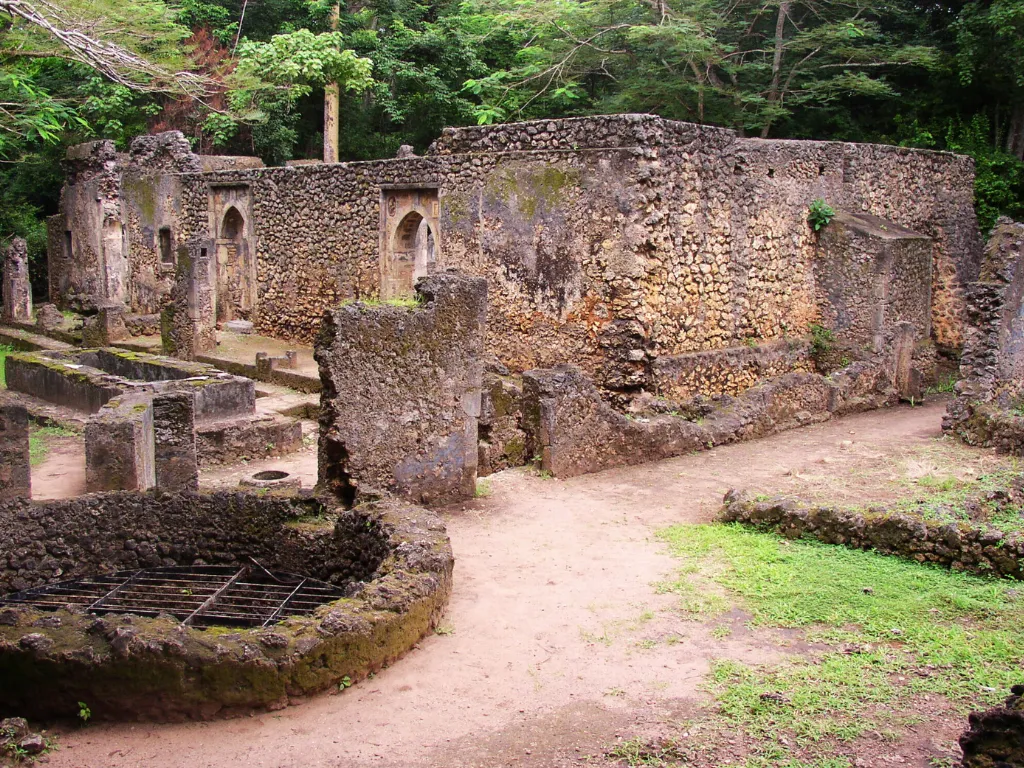
Archaeologists have also found that the inhabitants deepened the well outside the Great Mosque, an indication that the water table was growing significantly harder to reach, leaving the people without a necessary resource.
Introduction:
The ruins are the remains of a Swahili town, typical of most towns along the East African Coast.
It traces its origin in the twelfth century.
The Ruins have a rich vegetation of baobab trees, where you are greeted by the funny monkeys that live here and from whom you can bring bananas to eat.
Gede Ruins Museum Tour
With its numerous inhabitants, the town became wealthy, and reached its peak in the fifteenth century.
This enormous wealth is evidenced by the presence of numerous ruins, comprising of a conglomeration of mosques; a magnificent palace and houses all nestled in 45 acres of primeval forest.
But in the first half of the seventeenth century the last families left the town. Some buildings here still bear the architectural traces of Venetian rule.
Museum Diversity:
Admire valuable objects from all over the world.
With Chinese vases, coins from various European countries, an Indian lamp, porcelain objects from Persia, Chinese porcelain from the Ming dynasty, Venetian beads, Spanish scissors.
Gede remains the first intensively studied site on the coast. It was first visited by Sir John Kirk, a British resident of Zanzibar in 1884. Over forty years later in 1927, it was gazetted as a Historical Monument.
Two years later in 1929, it was declared a “protected monument” and in the late 1930s, the Public Works Department carried out work on preservation of its crumbling walls.
Thus, the first archaeological work at Gede began under the direction of James Kirkman followed by the first publication of the site.
In 1969, Gede’s administration was taken over by the National Museum of Kenya Trustees.
Starting and Ending
Hotels in Malindi or Watamu
Departure Time
Daily Departure of 1800 hours or 1400 hours
Return Time: Flexible
Wear: Comfortable clothing, hiking boots, hat, jacket and sunscreen.
Gede Ruins Museum Safari
The Gede Ruins were abandoned due to freshwater shortage and a raid by the Wazimba peoples.
It is now a National Museum and are heavily overgrown with beautiful indigenous forest trees, baobabs and tamarind.
The ruins of Gede are the relics of one of the Arab African settlements found along the East-African coast.
These towns were built by the Swahili people a couple of centuries ago.
Gede Ruins Sykes Monkey Malachite Kingfisher
Half Day Gede Ruins Tour 2026/2027
Conclusion:
The Gede Ruins Museum Tour is worth your time. It is very rich historically.
Gede Ruins Museum Safari